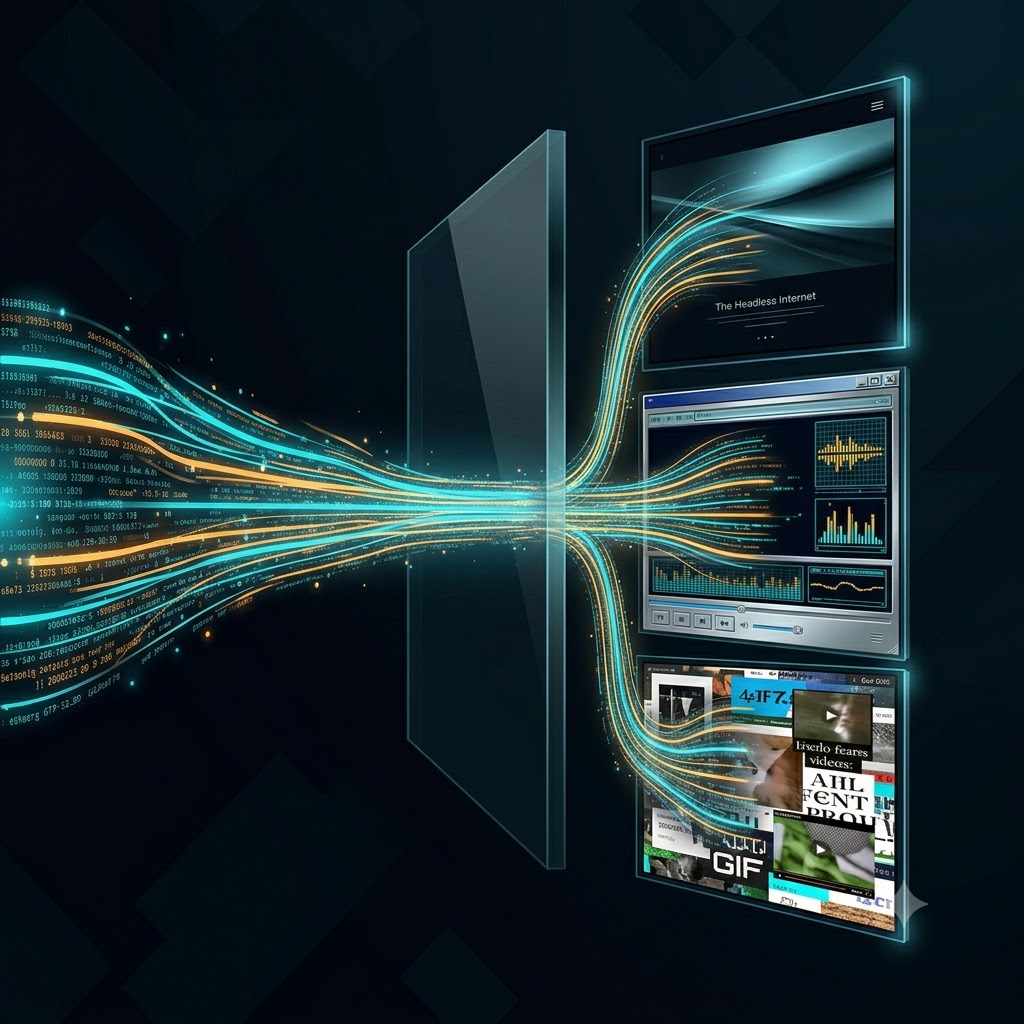
You have never actually seen YouTube.
You've seen a drawing of it. A red button, a rail of thumbnails, a sidebar built by people whose whole job is to keep you there four more minutes. That isn't YouTube. That's one rendering of YouTube. Underneath the rendering is the actual thing: a river of data, video ids and titles and timestamps, running past whether anyone paints it or not.
We forgot there was a difference. For most of the modern web the drawing was the only copy of the river anyone would hand you, so after a while we started calling the drawing by the river's name. YouTube IS the red button. X IS the timeline. Spotify IS that one shade of green, #1ED760, and the three taps it takes to reach your own library.
It wasn't always this way. Winamp let you reskin your music player into anything you could dream up. MySpace handed you the page and let you wreck it in your own taste. Your colors, your layout, your autoplaying profile song, even if it was a terrible Nickelback track that ambushed every poor soul who visited. The look and feel belonged to you. Then the platforms took the brush, and for some reason we let them.
So here's the question I keep circling. What if the river of data and the UI decoupled again? The drawing on one side, the water on the other, finally pulled apart.
The copy of a copy
You know how every time you copy a copy you lose a little fidelity? I've chased that idea all the way down before. The interface is that. It's a lossy copy of the data, optimized for someone else's incentives, and we've been treating the copy as the original for so long we stopped noticing the original was there at all.
But it never left. Every modern app is already a thin client talking to an API. The data and the pixels already travel down separate wires. The plumbing for a headless internet has been sitting inside your browser this whole time. We just never let you stand at the seam where they split.
Stand there for a second. On one side, the service does one honest job: it returns data. Clean, structured, no chrome, no growth team deciding what you should look at next. On the other side, you. And in between, a thing that takes the raw river and paints it however YOU want.
Show me YouTube in the calm cinematic grid of Netflix. Give me Spotify rebuilt as Winamp, skin and visualizer and all, because that's the software that actually felt like mine. Drop X back into the gloriously ugly freedom of old MySpace. Same river. A thousand renderings. The interface stops being something you're handed and becomes something you choose, or build, or install like a theme.
That's the headless internet. The body is the data. The head is whatever you decide to bolt on.
How it actually works
The old dream here was "just give me an RSS feed." That dream died for a good reason. Feeds were static, and the modern web is alive. Infinite scroll, lazy-loaded media, optimistic updates, interactions firing a hundred times a second. A reader app from 2008 couldn't keep up, so it lost.
The trick is to stop fighting the live machinery and start riding it.
Picture two layers. The first is an invisible wrapper. It swallows the live service whole and keeps every bit of its JavaScript engine running: the infinite scroll, the media that loads on demand, the real-time events. It doesn't kill any of that. It just refuses to show it. Instead it hands the behavior up as a clean stream of state.
The second is a visible canvas. It sits on top and paints that state into whatever you asked for. You scroll forever, media loads when you reach it, every button still works. None of it looks like the source anymore. The engine stays theirs. The face becomes yours.
I've built this shape before. Anyone who's shipped games has. You separate the simulation from the render. Positions, scores, inventories, events live in one layer. Sprites, shaders, UI live in another. Swap the renderer and the game still plays. Reskin the whole thing for a seasonal event and not one line of the simulation changes.
And here's the part that should scare every platform. Some of the biggest games ever made were players reskinning someone else's engine. Counter-Strike was a Half-Life mod. DotA was a custom map inside Warcraft III, and it went on to birth League of Legends and a whole genre. PUBG grew out of ARMA mods. The kids painting on top of the original kept winning, and a few of them ate the original alive. Nobody gave them permission. They just had the engine in their hands and a better idea of what to do with it.
The headless internet is that exact split, aimed at the whole web. Services become the simulation. Front ends become the render.
And the second you draw that line, something fun happens. You can gamify anything. A reading streak on your news source. XP for clearing your inbox. A leaderboard you and three friends share, stitched over data from platforms that never agreed to talk to each other. None of it has to be a feature the source ships. It's a feature you render, because you finally own the head.
Who's going to fight this
The platforms own the head on purpose. The interface is where the ads live, where the engagement gets measured, where the lock-in hides. Hand people the raw river and you hand them scissors for everything you monetize. So steelman their side for a second: they built the engine, they pay for the servers, they have a real claim that the experience is part of the product. That's not nothing.
Here's where I land anyway. The early headless web won't be granted. It'll be taken, the way ad blockers and userscripts and custom clients have always been taken, built on top of services that never opted in. Expect friction. Expect terms of service. Expect a long argument about who owns the experience of data you generated in the first place. The question of whether you even need permission is the whole fight, because your browser already receives every byte. Nobody has to grant you the right to repaint what's already in your hands.
And every time computing handed people more control over their own presentation, the personal homepage, the custom theme, the modding scene, they didn't trickle in. They flooded. The want has always been there. The only thing missing was a seam strong enough to deliver it on the living web. That seam is here now. Wrapper underneath, canvas on top.
Back to the river
So. You have never actually seen YouTube. You've been drinking from one cup someone else shaped, and calling the cup the water.
I don't fully know what happens when a few million people start shaping their own cups. Maybe the platforms wall it off and it stays a hacker's toy. Maybe it cracks the whole thing open and the web starts looking like the people using it instead of like four companies' design systems wearing slightly different colors. I lean toward open, because the river always finds the low ground eventually, and a billion people wanting their tools to fit their hands is a lot of gravity.
But that's the real question under all of this, and I'd rather leave you holding it than pretend I have the answer.
The data was always yours. So who gets to decide how it feels in your hands?