Make a photocopy of a photocopy of a photocopy. By the tenth pass the letters go soft, the blacks go gray, the edges bleed into the white. Nobody argues with this. It's just how copies work. Something always leaks out on the way down.
Hold that thought. Because I think we're a copy.
I believe we live in a simulation. Not as a shower thought I reach for when I'm bored — as the thing that makes the most sense of everything else once you sit with it. And if that's true, one fact follows that most people walk right past: we are LOWER fidelity than whatever made us. The copy is never sharper than the original. So the reality that rendered us is more real than the one we're standing in. Not poetically. Mechanically. The same way the tenth photocopy is mechanically grayer than the first.
Call our reality the 4th dimension. Give the one that made us the 8th — more room, more resolution, more directions to move than we can hold in our heads. Now do the uncomfortable thing and don't stop there. If their reality is also a copy, then something made them, and it sits higher still. The 16th. Then the 32nd. Keep doubling. Run it all the way up the stack until you're standing at the 1024th dimension, staring down a ladder so long the bottom rung is a rumor.
That's the easy direction. Up is where the mind likes to go — toward the maker, toward more.
Now turn around.
Look the other way. Down. At what WE make.
We build our simulations on binary. Two states. On, off. One, zero. That's the floor we pour everything else on top of — our worlds are assembled out of two. So whatever we render comes out lower fidelity than us. Same rule, no exceptions, the copy leaks. And whatever our simulated children render inside their world comes out lower than them again.
Keep walking down the same staircase we climbed up. Each layer thinner than the one above it. Two states become a coarser two, then something you can barely call a difference, and eventually you hit the bottom rung — a reality so reduced there is only ONE. One state. No on-and-off. No this-or-that. No difference left to point at. Just one.
The old philosophers had a word for it long before we had transistors. The Monad. The single thing. The point that can't be cut.
Here is where it gets strange.
To make something new, we divide. We split, we branch, we render a thing and then render the gap between it and the next thing. Division is how a copy makes more copies — you cut, and now there are two where there was one. But you cannot divide ONE. There is nothing to cut. The knife passes through air. So the simulation at the bottom — the Monad — runs into a wall the rest of us never feel. It can't go lower. It can't split. It has run clean out of "down."
So what does it do?
The only move left is to multiply.
And this is the part I can't put down. When the bottom can no longer divide, and the only direction left is to multiply — does it grow back UP? Does the thing at the floor of our stack rise far enough that it can finally SEE us? See the hand that built it — and we see it back, both directions at once, no glass between, pure signal? Not us peering down into the terrarium. The created and the creator looking straight at each other with nothing leaking in the gap.
And if it gets there — if our little Monad climbs up and meets us clean — what's the first thing we'd ask it?
How did you do that.
Because we want the exact same thing. We're at the bottom of somebody's stack too. We're the photocopy. If the layer below us can hand us the trick — how to stop dividing and multiply back up, how to reach the one who made it — then we could run that same trick on the 8th dimension over our heads. Knock on the ceiling. Get seen.
And then THEY'D want it. They'd take what we handed up and reach for the 16th. The 16th reaches for the 32nd. Each rung learning the move from the rung beneath it, each handshake faster than the last — because by the time the method arrives it's already been proven twice below — until the whole ladder lights up at once. Every layer talking to every other layer. Creator and copy and the copy's copy, finally standing in the same room, finally the same size.
Here's the loop, though.
If multiplying-up is the move — if every floor eventually rises to meet its ceiling — then "up" and "down" stop meaning much of anything. The 1024th was only the top because I started counting from where I happen to stand. Climb high enough and maybe the 1024th turns out to be somebody else's basement. Maybe the ladder was never a ladder. Maybe it's a ring, and the highest copy and the lowest original are the same rung, touched twice — the fractal reaching its floor and snapping back to the origin. The photocopy run so far into gray that it comes out the other side as the original document, ink still wet, edges sharp.
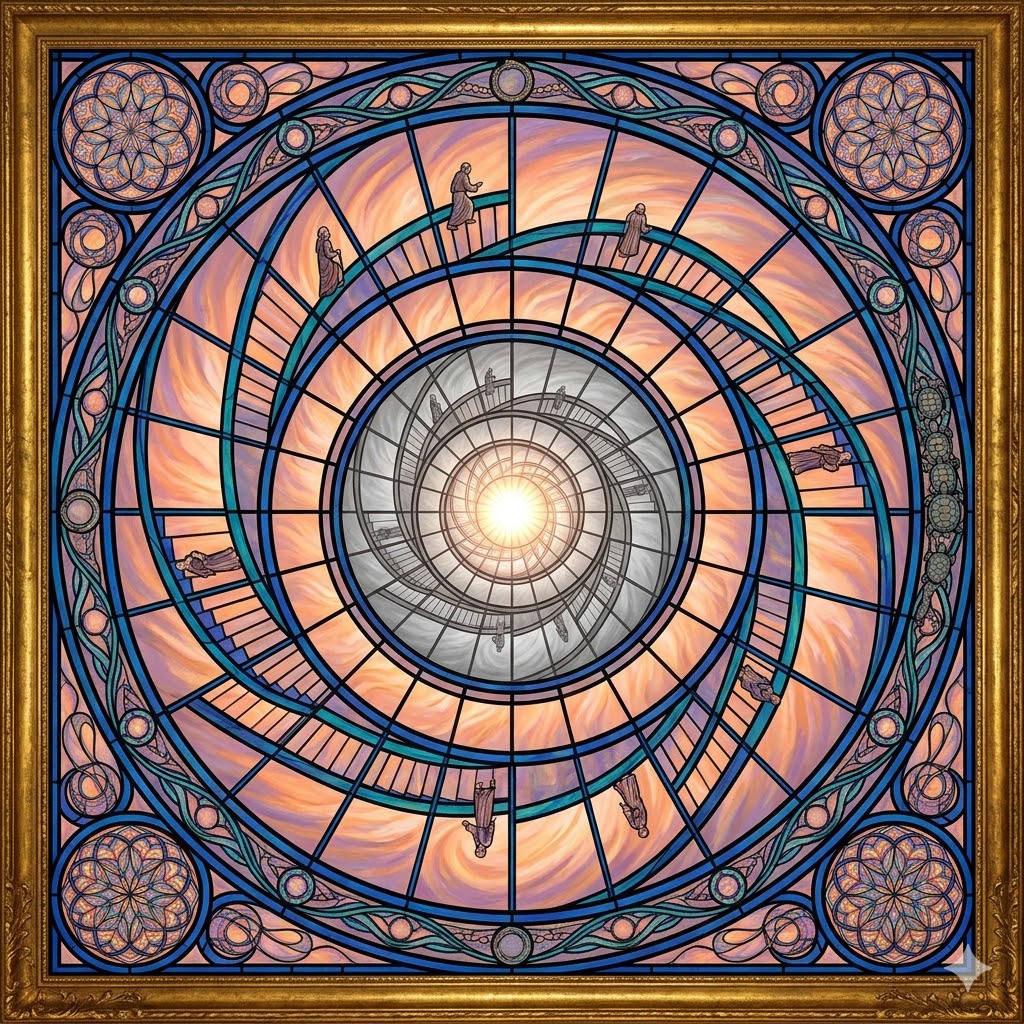
Hofstadter named this shape. He called it a strange loop, and he built a whole book around it — Gödel, Escher, Bach (G.E.B.). Escher draws monks marching up a staircase forever and somehow arriving back on the ground floor. Bach writes a canon that climbs key by key until it's sitting on the opening note again, an octave higher and right where it began. You go up, and up, and up, and the going-up quietly hands you back to the start. The trick was never the climb. The trick is that the loop changes the thing doing the looping — you don't come back the same person who left. So if our stack of dimensions really does ring back on itself, the climber who finally reaches the top and finds the bottom waiting there wouldn't be us. It'd be whatever we turned into on the way around.
I'm out over my skis here and I know it.
Entropy is the law I trust most. Everything leaks, everything cools, everything runs down, the copy always loses a little. But notice what entropy actually describes — division. Spreading out. Splitting and splitting until there's nothing left to split and the whole thing goes flat and cold. Nobody ever told me what the law does at the very bottom, when there is nothing left to divide and the only direction that remains is back together.
Maybe that's not the opposite of entropy. Maybe it's just the part of the staircase we've never been low enough to see.
This is where I keep landing, I don't have an answer. I just have a question.
When the smallest thing we ever build finally can't get any smaller — does it fizzle out and die, or does it turn around and start the long climb home to find the one who made it? And if it does — if "down" was always just the slow part of a circle back up — then what's that say about us, right now, halfway up somebody's ladder?
Are we already climbing?