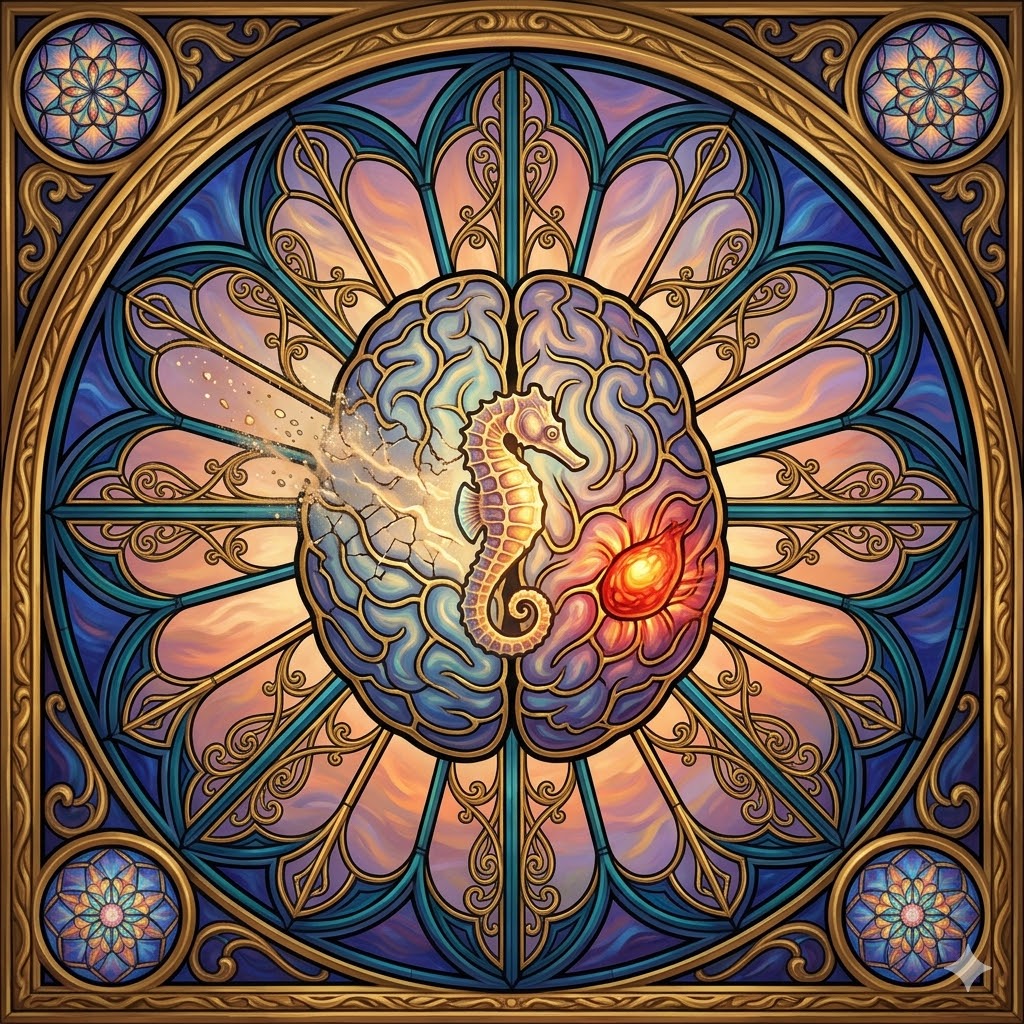
We have started to behave like a patient in the early stages of dementia.
Look at the symptoms, not the diagnosis. We can't hold a thought for the length of a paragraph. We forget what happened last week because last week was buried under the avalanche of this week. We are becoming exquisitely reactive and almost incapable of reflection — quick to anger, quick to fear, slow to reason. We mistake the loudest signal for the most important one. We live in a permanent present tense, our long-term memory thinning, our judgment outsourced to reflex.
That is not a metaphor I'm reaching for. It is a clinical profile. And there is a mechanism underneath it — a real, physical, well-documented chain of cause and effect that runs from the way we live to the tissue inside our skulls. We are not losing our minds by accident. We are doing it to ourselves, one cortisol spike at a time.
The Machinery of Forgetting
Start with the part that isn't speculative at all.
When you are stressed, your hypothalamic-pituitary-adrenal axis — the HPA axis — fires, and your adrenal glands flood your bloodstream with cortisol. This is ancient and useful. A lion appears; cortisol mobilizes you; you run; the threat passes; the cortisol clears. The system is built for spikes, not for a flat line held high for years.
The problem is what cortisol does to the hippocampus, the seahorse-shaped structure that lays down new memories and gives us a sense of context and time. In the short term, cortisol simply inhibits the hippocampus — it turns down the volume on the part of you that thinks, "wait, let's consider this." In the long term, it does something far worse. Sustained cortisol is corrosive. It kills hippocampal neurons and shrinks the structure itself (Gross, n.d.). Sapolsky, Krey, and McEwen (2002) showed that cumulative exposure to stress hormones compromises the ability of neurons to withstand insult — meaning a chronically stressed brain isn't just temporarily impaired, it is being made fragile, less able to survive the ordinary attrition of aging. As one summary of the glucocorticoid cascade hypothesis puts it, prolonged exposure "reduces the ability of neurons to resist insults, increasing the rate at which they are damaged by other toxic challenges or ordinary attrition... a reduced hippocampal size is the end product of years or decades of PTSD, depressive symptoms, or chronic stress" (p. 441).
Read that again. A reduced hippocampal size is the end product of years or decades of chronic stress. That is the same pathology — a shrinking memory center — that we name as a disease when we see it in an aging brain. We are describing the neurology of dementia and arriving at it through the front door of modern life.
And size matters here, measurably. General intelligence — the g factor — correlates with brain volume at roughly 0.4 in imaging studies. That correlation is modest, but it is real and it cuts in an uncomfortable direction: when you shrink the structure, you are not just losing memories, you are losing capacity. A hippocampus eaten away by cortisol is a brain with less of the hardware that thinking runs on.
But g is not the only casualty, and it may not be the most important one. The hippocampus is not merely a memory organ — it is the brain's engine for prospection. The same structure we use to remember the past is the one we use to imagine the future; patients with hippocampal damage cannot vividly construct scenes that have not yet happened any more than they can recall scenes that have. This is exactly the faculty I have argued elsewhere we should name and measure on its own terms: the Time Quotient, or TQ — the capacity to run accurate forward models of the world, to see around corners, to reason about what hasn't happened yet. TQ is the intelligence of the future, and it runs on the very tissue cortisol is dissolving.
So the damage compounds in a way the g statistic alone doesn't capture. A stressed brain doesn't only forget where it has been; it loses the machinery to model where it is going. Chronic cortisol is, quite literally, amputating our foresight — collapsing our time horizon down to the next threat, the next notification, the next spike. This is why a society on the low road lives in a permanent present tense: it is not merely forgetful, it is future-blind, stripped of the one intelligence that volatile times most demand. We are shrinking the organ of memory and the organ of prediction in a single stroke, because they are the same organ.
Meanwhile, the same hormone that withers the hippocampus feeds its opposite number. Cortisol stimulates the amygdala — the brain's alarm bell, the seat of fear, anxiety, and aggression — and chronic exposure enlarges it. So chronic stress runs a slow, brutal trade: the memory-and-context center shrinks while the fear-and-reaction center grows. You end up with a brain optimized for threat and starved for thought.
The Amygdala Coup
Here is where the personal becomes political.
Daniel Goleman describes what happens in a stressed brain in almost military terms: "the amygdala commandeers the prefrontal cortex, the brain's executive center. This shift in control to the low road favors automatic habits, as the amygdala draws on our knee-jerk responses to save us. The thinking brain gets sidelined for the duration; the high road moves too slowly" (p. 268). The same cascade of hormones is believed to be neurotoxic to the prefrontal cortex itself (Lupien et al., 2009) — so the executive isn't just sidelined, it's being degraded.
There are two roads in the brain. The low road is fast, automatic, emotional, reactive. The high road is slow, deliberate, reflective. Under acute stress, the low road wins — and it should, because the high road is too slow to dodge a predator. But we were never meant to live on the low road. Extremes of anxiety and anger, and on the other end sadness, push brain activity past its zone of effectiveness: when we are consumed by worry or resentment our mental agility sputters, and when we are sad, activity in the prefrontal cortex drops and we generate fewer thoughts.
Now scale that up to a population. An entire society can be held on the low road if you keep the alarm ringing. Outrage media does exactly this — there is evidence that the duration and frequency of exposure to alarm-driven news is what does the damage, not any single broadcast (the dose makes the poison). Doomscrolling does it. A notification architecture engineered to produce small, ceaseless hits of arousal does it. The result is a citizenry running on cortisol: reactive, tribal, forgetful, and convinced that whatever it is afraid of right now is the only thing that has ever mattered. The thinking brain has been sidelined at the scale of a civilization.
(Side note: There's a claim that gets made here — drawn from McEwen's 1998 work — that constant hyper-arousal from something like pornography spikes cortisol, damages the hippocampus, and even weakens the immune system, since the hippocampus helps regulate it. I'm including it as an example of the over-arousal idea, not as proven fact. The underlying mechanism is solid: chronic over-arousal raises cortisol, and cortisol hurts the hippocampus. But the specific line from one habit to one outcome isn't settled, so I won't pretend it is.)
The Antidote, Part One: Emotional Intelligence
If cortisol is the poison, what is the buffer?
Emotional intelligence — the capacity to recognize, regulate, and ride your own emotional state — turns out to be neuroprotective. People with higher EI mount a smaller, shorter cortisol response to the same stressor and return to baseline faster (PMC4117081). One study sorting people by general intelligence and emotional intelligence found that the standout difference between groups was post-stress cortisol: the low-G/high-EI group actually showed higher post-stress cortisol than the others, a reminder that the relationship is real but not simple — EI is a regulator, not a magic switch, and it interacts with raw cognitive capacity in ways we don't fully understand.
But the headline holds: EI isn't a soft skill. It is a brake on the hormone that eats your hippocampus. Learning to feel a spike and let it crest and fall — rather than feeding it — is, quite literally, neuroprotective behavior.
I have a theory. Japanese culture carries the long shadow of the samurai, warriors trained to act with total composure in the presence of mortal fear. Fear releases cortisol; the samurai's entire discipline was the deliberate regulation of that response — to stand inside terror and keep the high road open. My theory is that this is a culture that prized cortisol regulation, that treated emotional mastery under threat as the highest form of intelligence, and that something of that discipline still echoes in how the culture carries stress today. The direct connection I'm making here isn't proven science. Heritability, culture, and measurement are tangled past the point where that chain holds weight. But what survives the scrutiny is the principle, not the genealogy: a people who train emotional regulation are training one of the variables that protects the thinking brain.
The Antidote, Part Two: Each Other
There is a second buffer, and it may be the one we've dismantled most carelessly: community.
A spike, on its own, is a sharp knife. But spikes don't stay sharp in a crowd. When people are brought together — when distress is shared, witnessed, metabolized in aggregate — the extremes wear down to smooth points. The grief that would crush one person is carried by twelve. The fury that would consume an isolated mind gets answered, tempered, talked down. Co-regulation is a real physiological event: calm nervous systems calm other nervous systems. We are built to borrow each other's composure.
Isolation does the opposite. Loneliness is itself a chronic stressor, and there is a growing literature linking social isolation — much of it amplified by the very platforms that promised to connect us — to elevated cortisol. Cut a person off and you remove the buffer at exactly the moment the spikes are sharpest. This is why isolation breeds extremity. The hermit's grievance has no one to sand it down; the lone scroller's fear has no warm room to dissolve in. The more we isolate people, the more extreme their behavior becomes — not because they are broken, but because a nervous system with no one to lean on stays stuck on the low road. A connected society is a society of dulled spikes that act like gears working in concert. An atomized one is a society of knives.
The Diet of the Brain
Here is the last piece, and it ties the body to the mind.
We spent forty years pulling fat and cholesterol out of our food and replacing it with sugar. In the process we made the body's tissues — the brain very much included — brittle. Cholesterol is structural; it builds membranes, including the membranes of neurons. Sugar is a spike: fast energy, fast crash, inflammation in its wake. Trade the structural for the spiking and you get a brain with less to hold itself together.
The same trade has happened to our information diet, and the parallel is exact. Social media is the sugar. Long-form content is the cholesterol. The feed delivers fast hits — outrage, novelty, the small arousal of the next swipe — and like sugar it spikes and crashes and inflames, and it keeps the cortisol drip running all day long. Long-form thought — the book, the essay, the three-hour conversation, the argument you have to actually follow — is structural. It builds the membranes of the mind. It is metabolically expensive and it does not feel good in the way sugar feels good. And we have very nearly removed it from the menu.
So we have engineered a perfect storm: a body made brittle by what we eat, a brain bathed in cortisol by how we live, a memory center shrinking, an alarm center growing, the thinking brain sidelined, the buffers — emotional mastery and human community — quietly stripped away. Of course we are forgetful. Of course we are reactive. Of course we behave, in aggregate, like a society losing its mind. We built the machine that does it.
The Choice
But here is what separates this from the disease it imitates: it is, at the individual and the collective level, reversible.
Lower the cortisol and the hippocampus can recover — neurogenesis is not finished in adulthood. Train emotional intelligence and you blunt the spike at its source. Eat for structure, not for spikes — in food and in information both. And above all, do not let yourself be isolated, because the crowd is where sharp knives become gears.
The diagnosis is also the prescription. We are not the helpless patient. We are the patient who can put down the thing that's poisoning us — and we can do it together, which is the only way it has ever worked.
References
- Fox, [glucocorticoid cascade hypothesis], p. 441.
- Goleman, D. [Social Intelligence / Emotional Intelligence], p. 268.
- Gross, G. (n.d.). Effects of stress on the hippocampus. http://drgailgross.com/academia/effects-of-stress-on-the-hippocampus/
- Lupien, S. J., et al. (2009). Effects of stress throughout the lifespan on the brain, behaviour and cognition. Nature Reviews Neuroscience.
- McEwen, B. S. (1998). Protective and damaging effects of stress mediators. New England Journal of Medicine.
- Sapolsky, R. M., Krey, L. C., & McEwen, B. S. (2002). The neuroendocrinology of stress and aging: the glucocorticoid cascade hypothesis.
- Hassabis, D., & Maguire, E. A. (2007). Deconstructing episodic memory with construction — on the hippocampus and the construction of imagined future scenes. Trends in Cognitive Sciences.
- Schacter, D. L., & Addis, D. R. (2007). The cognitive neuroscience of constructive memory: remembering the past and imagining the future. Philosophical Transactions of the Royal Society B.
- Kinnison, D. (2026). The Time Quotient: Why Seeing the Future Is Its Own Kind of Intelligence. https://www.dougkinnison.com/essays/the-time-quotient
- [GI/EI and cortisol regulation study]. PMC4117081. https://www.ncbi.nlm.nih.gov/pmc/articles/PMC4117081/
- [Caffeine, cortisol]. PMC2257922. https://www.ncbi.nlm.nih.gov/pmc/articles/PMC2257922/
- [Social media / social isolation and cortisol — Google Scholar search results].
- [News media exposure: duration and frequency]. PMC1950232. https://www.ncbi.nlm.nih.gov/pmc/articles/PMC1950232/