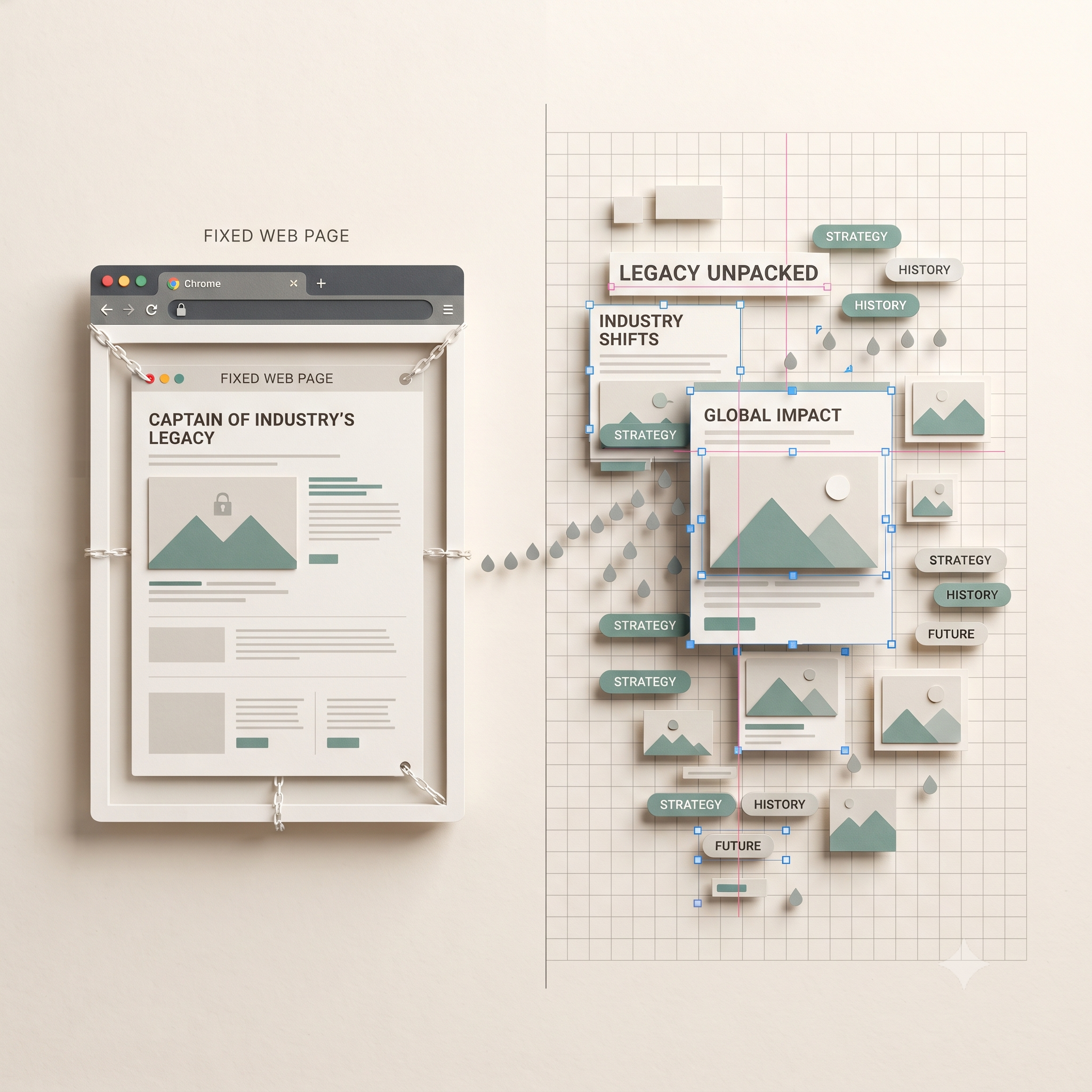
Here's the claim: the browser is a layout engine pretending to be the look and feel of the internet. And the moment we stop sending layouts across the wire and start sending only data, the most valuable seat on the internet isn't Chromium. It's a canvas. Figma is already a canvas.
This only sounds crazy until you look at what a webpage actually is.
Right now, when you load a news site, the site sends you three things bundled together — the data (the headlines, the bodies, the images), the structure, and the look. The site decides all three. You get rows because they gave you rows. You get their fonts, their ad slots, their idea of what matters at the top. You are a guest in their layout. You always have been.
Chrome is very good at this, and I want to give credit where credit is due. Chrome renders someone else's decisions faster and more reliably than anything we've ever built, across a billion machines, for free. That's not nothing — that's one of the engineering miracles of our lifetime. If the job is "show me exactly what the publisher built," Chrome wins and it isn't close.
But what if that's not the job anymore?
Headless already happened
Did you know that everything has been quietly going "headless" for a decade? The backend that holds the data got divorced from the frontend that shows it. Sites stopped being pages and became APIs with a coat of paint. The data is already traveling separately from the look — we just keep re-gluing them at the last second out of habit, because the browser expects a page.
So strip the habit. Imagine the news site sends you the DATA and nothing else. Six stories. Tags, headlines, blurbs, images, timestamps. A clean payload. No layout opinion attached.
Now the question flips. If the site isn't deciding how this looks — who is?
You are.
The site sends a payload, you pick the lens
Say I'm reading The Wire, the data lands. I tell my reader: show me this as a finance feed, dense rows, the way I'd scan a terminal. Later I'm tired and I want it to feel like a magazine, so I say: give me big swipe cards instead, same six stories, different layouts. Nothing got re-downloaded. I just pointed a different template at the same data.
Once the layout is a template you choose and not a page you receive, the layout becomes YOURS. You can keep a few. You can keep one for markets in the morning and one for long reads at night. The waiter shows you ingredients; you decide whether it's a taco, nacho, or burrito.
And here's where it gets fun, because this is exactly the kind of thing a design tool was born to do.
Tinder for news, built by you
Watch what happens when I push it. I take those same six stories and I say: don't give me a list. Give me a deck. One card at a time, full bleed, swipe left to kill it, swipe right to keep it. News as Tinder.
But the swipe isn't just a gesture. Every left and every right is a vote, and the votes pile up by tag. Swipe right on three Bitcoin stories and pass on the culture pieces, and you've just told your own reader what you want more of. No recommendation engine in a data center decided that. YOU did, with your thumb, in ten seconds. You wrote the algorithm by using it.
I built a small version so you can feel it instead of taking my word for it. Same payload, three lenses — feed, swipe cards, Tinder. Flip between them. Then swipe a few and watch the bars at the bottom move.
This is one self-contained HTML file dropped into the post — no build step, no libraries, all client-side. The demo IS the argument: a portable layout shell wrapping data it didn't create.
Notice what that little widget actually proves. The data never changed. Three completely different experiences came out of one payload, and the third one let you steer your own ranking. It's one set of data and three pairs of glasses.
Why a design tool, and not just a better browser
If the layout is the product, then the place where layouts get MADE is the high ground.
I spent years as a creative developer living in Framer, Figma, and XD, and the thing those tools quietly perfected is real-time, shared, drag-it-around design that updates live for everyone looking. A browser renders one frozen design. A canvas lets you reshape the design while you're standing in it — and hand the new shape to a friend mid-sentence, like a massive online multiplayer video game around content rather than death matches in Battlefield 6. Real-time collective research instead of collaborative mining for minerals in Minecraft.
So picture the canvas as the reader. The data flows in, you drag a row component onto it, bind it to the feed, and you've got a list. Don't like it — swap the row for a card component, same binding, now it's a deck. Want the Tinder behavior — drop in a swipe component. You are designing your own internet in the open, and because it's a design surface, you can SHARE the layout the same way you'd share a design file. "Here's my markets-at-6am view, take it." Custom web experiences become things people make and pass around, not things a company ships to a billion people identically.
That last part is the whole game. New features and new layouts stop coming from the site and start coming from the crowd. The publisher controls the data, the community builds the narrative and experience.
Why might this fail?
Now, the obvious objection, and it's a good one: publishers will fight this to the death. Their layout is their business, and the business converts ads into revenue. A world where I strip your page to its data and view it however I want is a world where your homepage stops existing. That's a real fight, not a technical one, and I won't pretend a clean payload arrives just because it'd be elegant. Cui bono, who benefits, follow the money. It is what controls this whole thing and it won't give up without a fight.
It could lose, and Figma-the-company may never be the thing that does this, maybe it's a fork, a new tool, something nobody's named yet. I'm not betting on a logo. I'm betting on the data.
So back to where we started. The browser is a layout engine pretending to be the look and feel of the internet. For thirty years we let the layout ride in with the data because separating them was hard. It isn't hard anymore. And once the data shows up naked, the question stops being "what did they build for me" and becomes "what do I want to build for myself."
Chrome shows you the room someone else decorated, and a canvas hands you the paint.